
Python Fundamentals Series · Part 1 of 3
Complete Python Course | Fundamentals to Advanced Concepts
Python Foundations · Day 0 (Course Introduction)
Before You Start: The Complete Python Course Roadmap
What this course covers, how it's structured, who it's for, and how to follow it so the learning actually sticks.

"Bas mehnat karne ka control hai, wo toh kar kam-se-kam." Hard work is the only thing in your control, so at least do that.
This isn't a lecture. Day 0 is your orientation: what you'll learn, how the course runs, where to find everything, and how to get the most out of it.
What Is This Course?
Babua Python Programming: From Fundamentals to Advanced Concepts is the first course in the Babua Placement Series 2026.
It doesn't stop at variables, loops and if-else. It starts from the absolute basics and goes all the way to the concepts that separate a beginner from an engineer: generators, file operations, decorators, threading, and how to write production-quality, maintainable Python.
The approach is different too. The focus isn't on memorising syntax. It's on how an engineer studies a language: what happens at the memory level, and why Python behaves the way it does. Learn one language this way, and you'll pick up every language after it much faster.
Where Python Fits: The Placement Roadmap
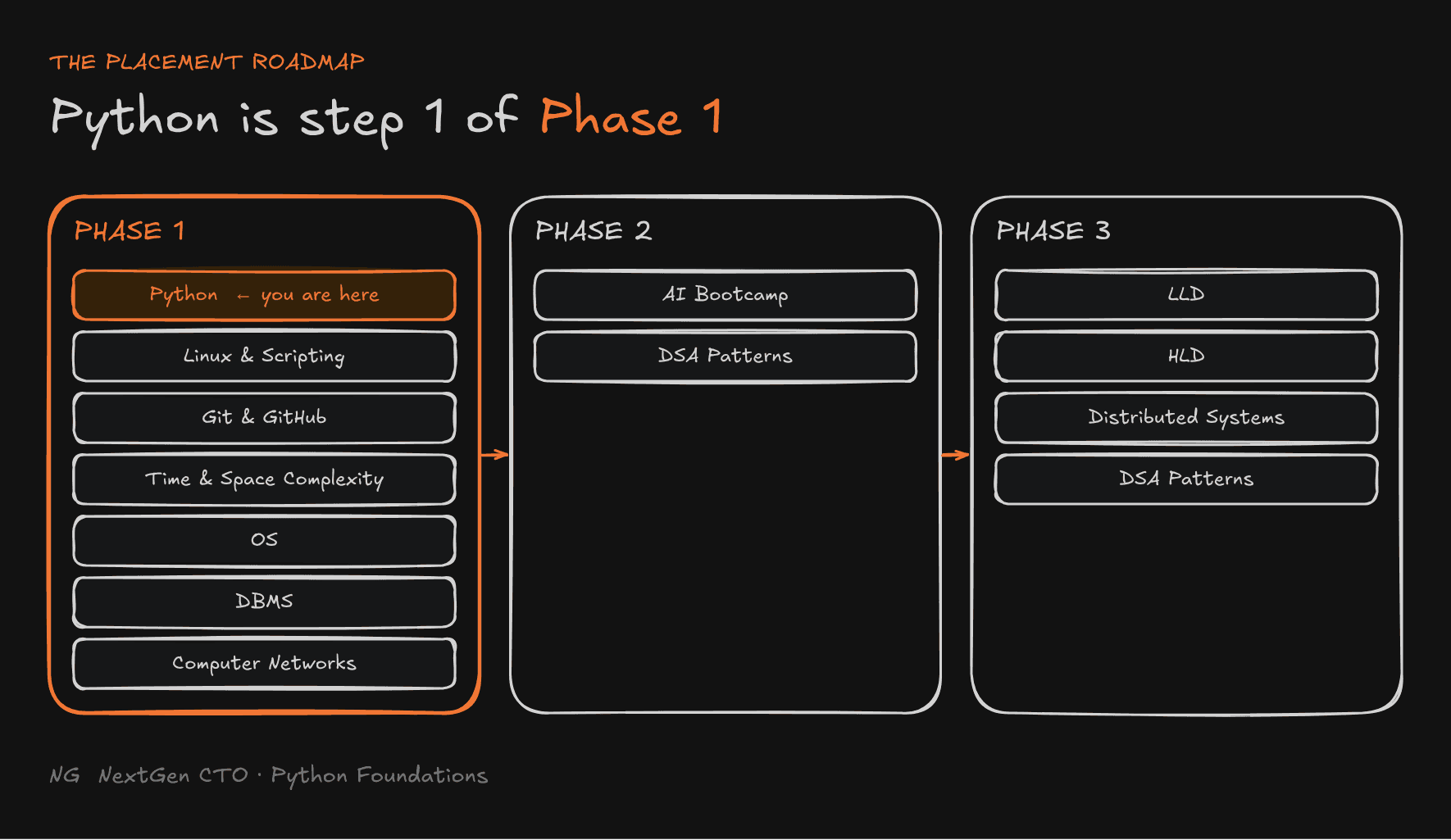
Python is the first step of a three-phase placement plan:
This course is the first item in Phase 1.

What You'll Learn
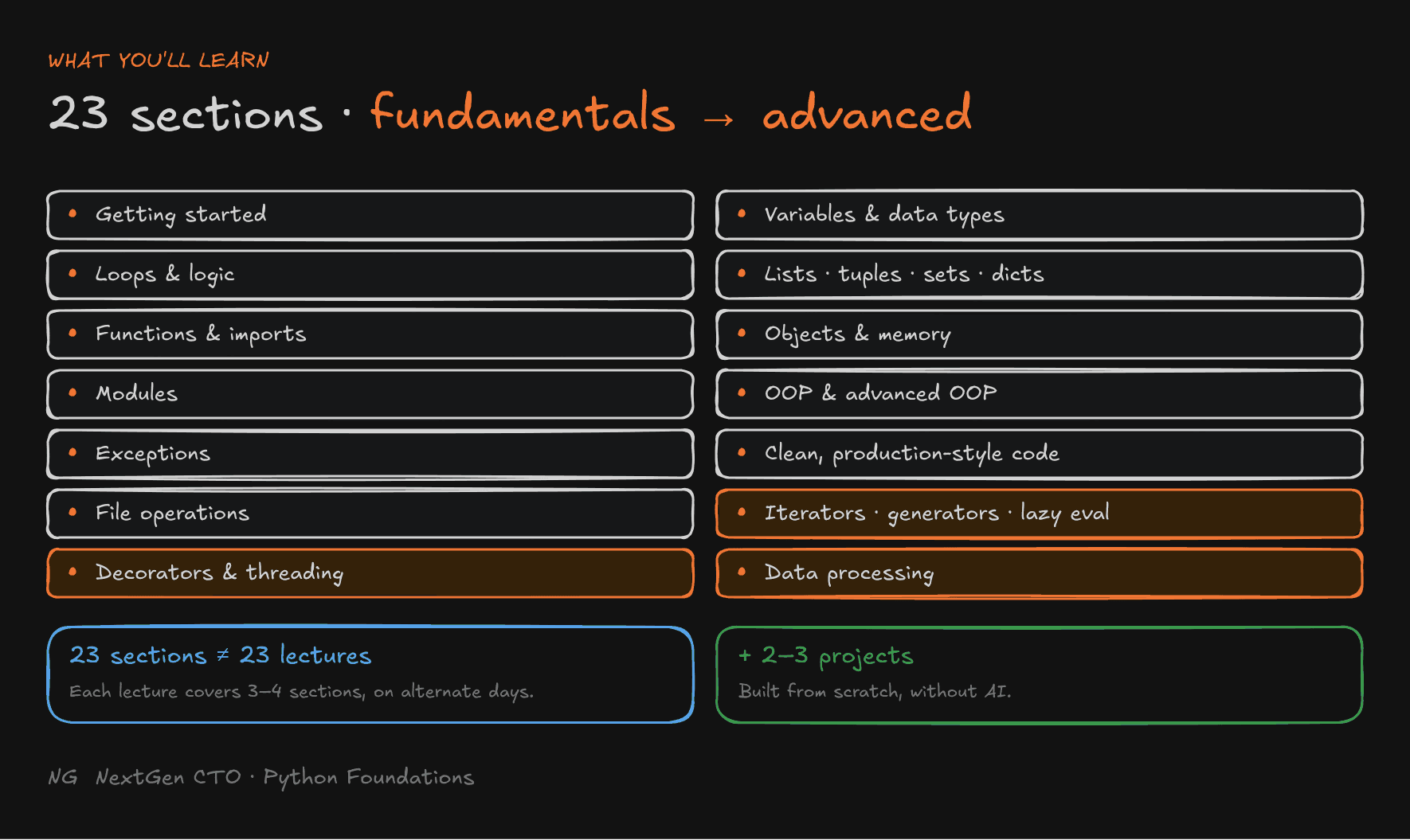
The course is divided into 23 sections, moving from fundamentals to advanced topics:
- Getting started: your first Python program
- Variables and data types
- Loops and logic
- Python data structures: lists, tuples, sets and dictionaries
- Functions, parameters and imports, plus programming techniques
- Objects and memory: what happens at the memory level
- Modules
- Object-oriented programming, including advanced OOP
- Exceptions
- Writing good Python: clean, reliable, maintainable, production-style code
- File operations
- Iterators, generators and lazy evaluation
- Decorators and threading
- Data processing and application-level Python
Along the way, you'll also build two or three projects from scratch, without using AI.

23 Sections Doesn't Mean 23 Lectures
If each section got its own lecture on alternate days, Python alone would take 46 days. That's too slow, and it would delay everything after it.
So each lecture covers 3 to 4 sections. A large section might take a whole lecture, but most days you'll move through several. Lectures come out on alternate days.
How Every Lecture Works
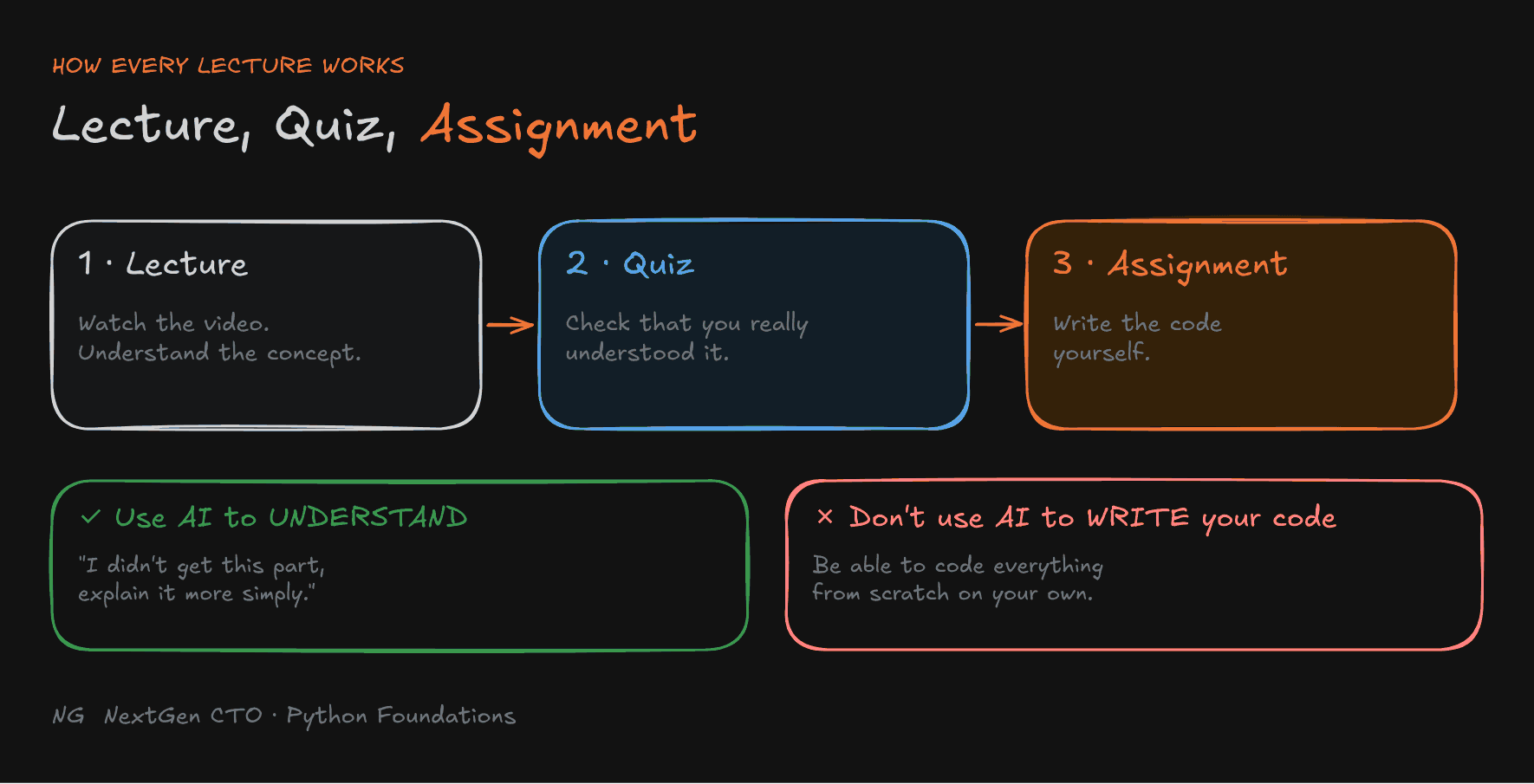
Every lecture comes in three parts:
- Lecture: watch the video and understand the concept.
- Quiz: check that you've really understood it.
- Assignment: write the code yourself.
The quizzes and assignments are on the platform.
The AI rule: use AI to understand ("I didn't get this part, explain it more simply"). Don't use it to write your code. The goal is to be able to code everything from scratch on your own.

How to Follow This Course
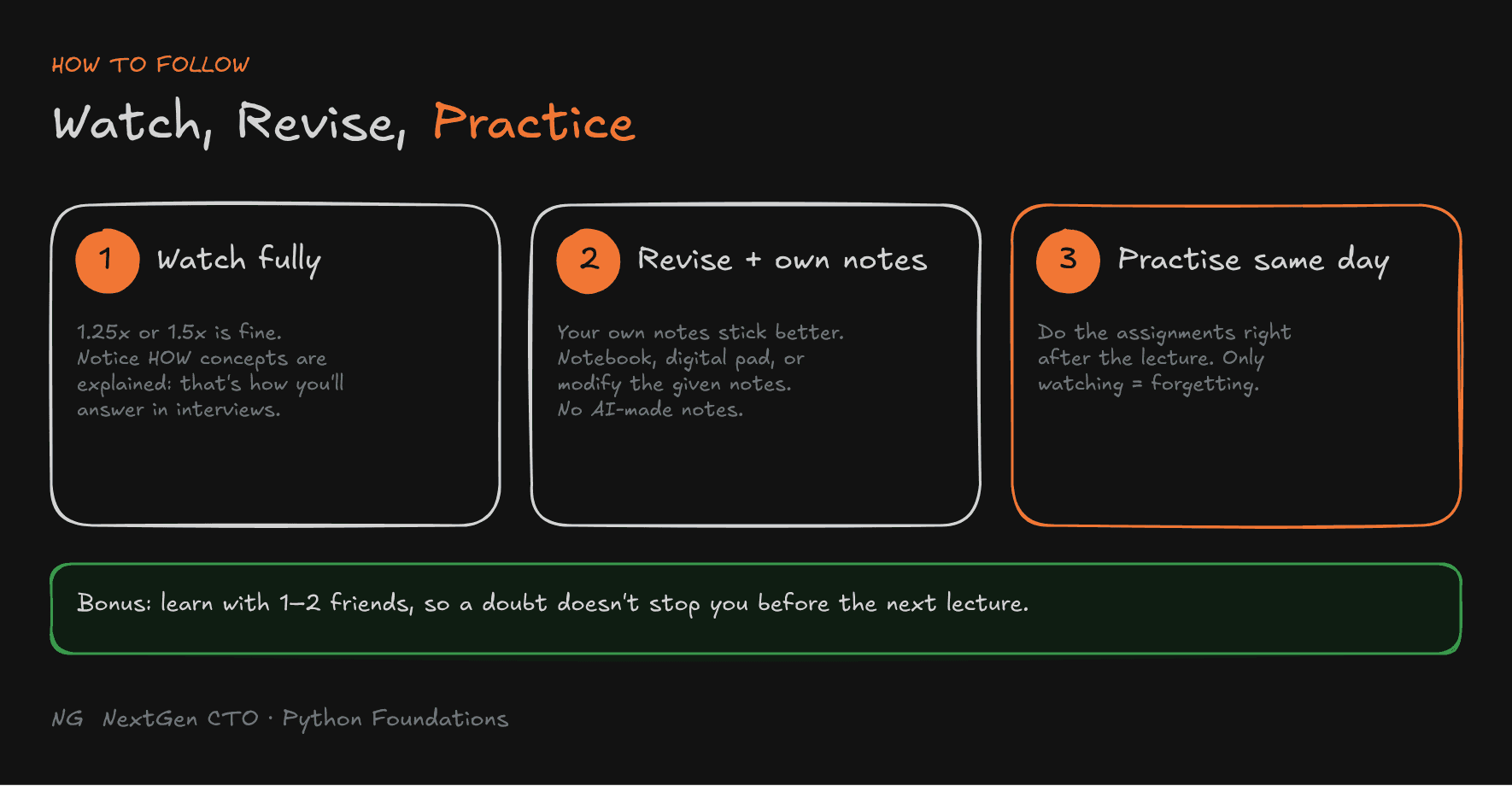
1. Watch the full video. Watching at 1.25x or 1.5x is fine, but watch the whole thing. Notice how concepts are explained, because that's how you'll need to explain them in interviews.
2. Revise and make your own notes. Notes are provided, but your own notes stick better. Use a notebook, a digital pad, or modify the provided notes. Avoid using AI to make your notes.
3. Practise on the same day. Finish the assignments as soon as the lecture ends. If you only keep watching, you quickly forget both the syntax and the concepts.
Bonus: learn with 1–2 friends. When you get stuck on a doubt, someone studying alongside you can unblock you before the next lecture comes out.

Where to Find Everything
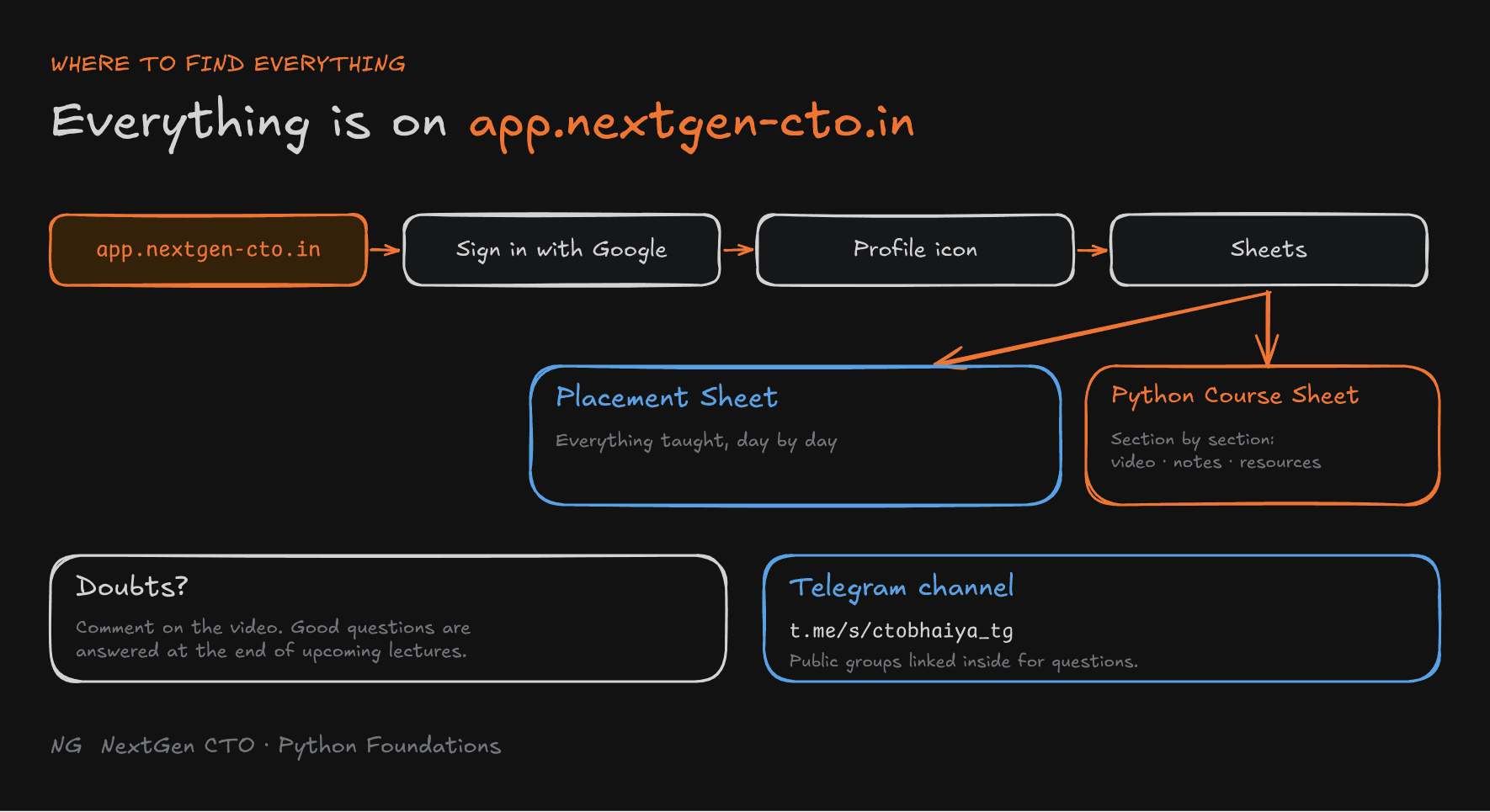
All notes, sheets, quizzes and assignments are on the NextGen CTO platform:
- Go to app.nextgen-cto.in and sign in with Google.
- Click your profile icon and open Sheets.
- You'll find two sheets:
- Placement Sheet: everything taught, day by day
- Python Course Sheet: the course, section by section, with the video, notes and resources for each part
Doubts? Comment on the lecture video. Good questions are answered at the end of upcoming lectures. There's also a Telegram channel for updates (t.me/s/ctobhaiya_tg), with public groups linked in it where you can ask questions.

Who Is This Course For?
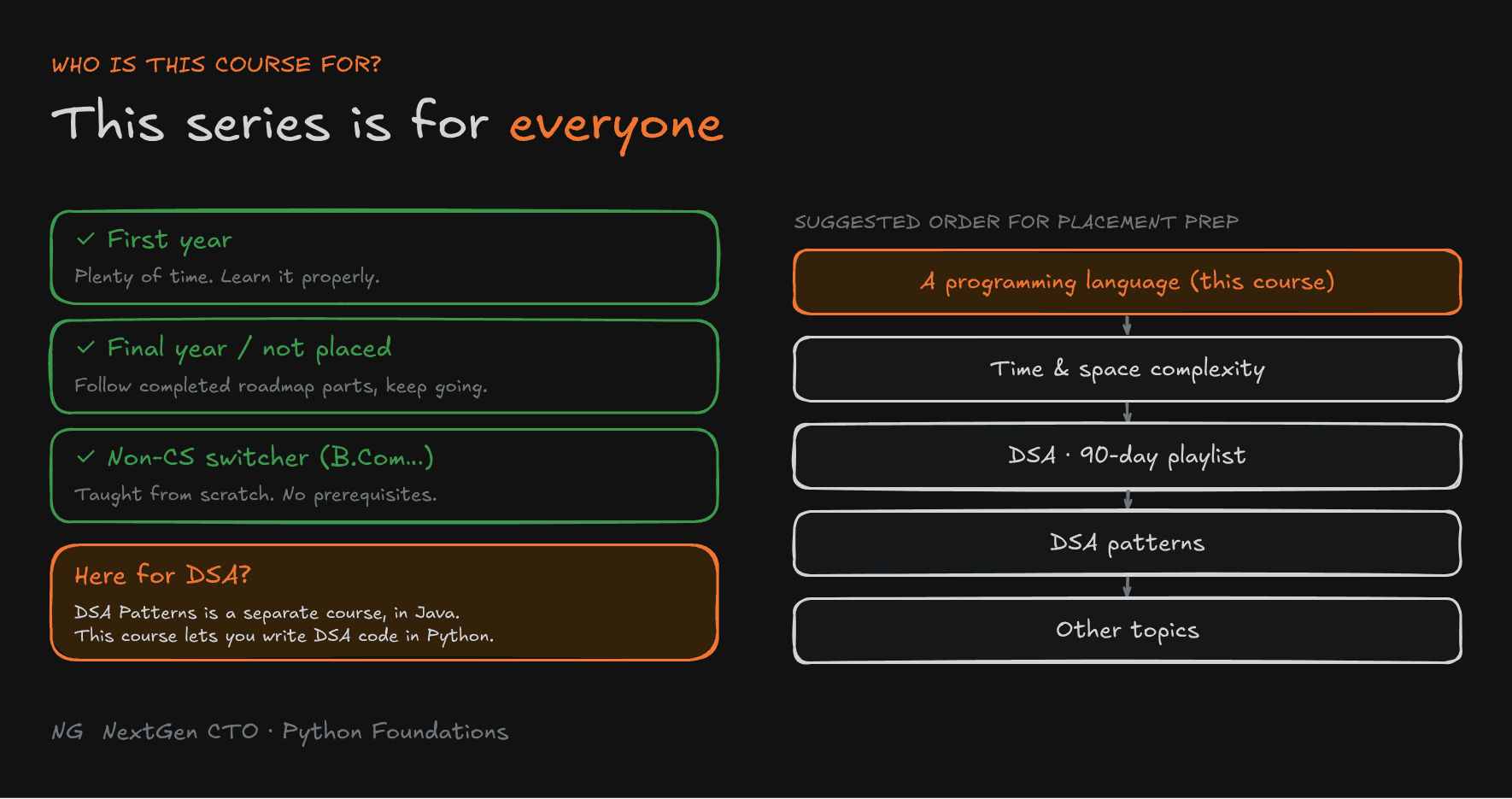
Everyone. First-year, second-year, final-year, or someone switching into tech from a non-CS background like B.Com. The course is taught from scratch.
- First year? Great. You have plenty of time to learn properly.
- Short on time (final year, not yet placed)? Follow the parts of the roadmap that are already complete, and keep going.
- Here for DSA? This isn't a DSA course. The DSA Patterns course is taught separately, in Java. This course teaches you enough Python that you can write your DSA code in Python if you prefer.
Suggested order for placement prep:
A programming language (this course)
   → Time & space complexity
   → DSA (90-day playlist)
   → DSA patterns
   → Other topics

From the Q&A
- "Will this series actually be completed?" Yes. The focus is on consistency and quality, not speed, so there's no fixed timeline. Your likes, comments and engagement are what keep the series moving.
- "Which language will LLD be taught in?" The plan is Python, but the language barely matters for LLD. The design concepts are what count.
- "Are the basics enough to get placed?" Knowing the basics is good, and most people still don't. But today it isn't enough. Build something extra, show your work, and network: reach out on LinkedIn to people doing good work, and show them what you've built around their area.
Key Takeaways
- This course takes you from Python fundamentals to advanced concepts like generators, decorators and threading, and it's the first step of Phase 1 of the placement roadmap.
- 23 sections, with 3–4 sections per lecture, released on alternate days.
- Every lecture is Lecture → Quiz → Assignment. Use AI to understand, not to write your code.
- Follow the course in three steps: watch fully, revise with your own notes, practise the same day. Study with 1–2 friends.
- Everything lives on app.nextgen-cto.in, under Sheets.
The main principle: you only control the effort, so put it in every day.
Up next → Part 1: Introduction to Python